Forex Position Sizing: How to Protect Your Account Before You Place a Trade

Forex position sizing is the thing most blown accounts have in common. Not bad analysis. Not bad timing. Just too much on the line when a trade goes wrong. This article covers how to calculate position size, why it matters more than your entry, and how to stop drawdown before it becomes a crisis. Read this before your next trade.
Table of Contents
- Why Position Sizing Decides Your Survival in Forex
- How to Calculate Position Size in Forex
- Position Sizing Strategy: The 1–2% Rule Explained
- Common Position Sizing Mistakes and How to Avoid Them
- Choosing Tools That Support Smart Position Sizing
- Key Takeaways
- Conclusion
- FAQ
Why Position Sizing Decides Your Survival in Forex
Most traders spend the majority of their time hunting for the perfect entry. They obsess over indicators, chart patterns, and economic calendars. And yet the traders who blow their accounts rarely do so because their analysis was wrong. They do so because they risked too much on a single trade.
Position sizing in forex refers to how large a position you open relative to your account balance. It's the dial that controls how much damage any single losing trade can do. Turn it too high and one bad week can erase a month of careful gains. Set it correctly and you can absorb a losing streak of ten trades and still have enough capital left to rebuild from.
Retail forex traders consistently lose money due to persistent patterns of overleveraging among newer accounts. Leverage, which means borrowing from your broker to control a position larger than your own capital allows, amplifies both gains and losses. Pair it with oversized positions and the combination can be devastating.
Here's the honest reality: your position size is the one variable you fully control before any trade begins. Entry timing is an estimate. Market direction is uncertain. But how much you risk is entirely your decision, and that's worth taking seriously.
How to Calculate Position Size in Forex
Knowing how to calculate position size in forex comes down to three inputs: your account balance, the percentage you're willing to risk per trade, and your stop-loss distance in pips. A pip is the smallest standard price movement in a currency pair, typically 0.0001 for most majors, and every calculation you run depends on it.
The formula works like this:
Position size (in lots) = (Account balance x Risk %) / (Stop-loss in pips x Pip value)
Let's apply it with a concrete example:
- You have a $10,000 account.
- You decide to risk 1% per trade, which equals $100.
- Your stop-loss sits 50 pips below your entry.
- For a standard lot of EUR/USD, each pip is worth approximately $10.
So: $100 / (50 x $10) = 0.2 lots.
That means you open a 0.2 lot position, also called a mini-lot position. If the trade hits your stop-loss, you lose exactly $100, or 1% of your account. Your remaining $9,900 is fully intact. Which brings us to the actual rule most professionals use to decide what that risk percentage should be.
Position Sizing Strategy: The 1–2% Rule Explained
The 1–2% rule is the most widely used position sizing strategy among professional retail traders. Simple enough to state: never risk more than 1–2% of your account balance on any single trade.
Sounds conservative. Run the numbers and it stops sounding conservative pretty quickly. Risk 2% per trade and hit a losing streak of ten consecutive trades, which does happen to even skilled traders, and you still retain roughly 82% of your starting capital. Risk 10% per trade under the same conditions and you're sitting at less than 35%.
|
Risk per trade |
10-trade losing streak |
Capital remaining |
|
1% |
10 losses |
~90.4% |
|
2% |
10 losses |
~81.7% |
|
5% |
10 losses |
~59.9% |
|
10% |
10 losses |
~34.9% |
The table makes the compounding effect of risk management visible. Small risk percentages leave you with enough capital to recover. Larger ones can make recovery mathematically difficult, and that's before you factor in the psychological weight of watching your account fall apart.
Some experienced traders pull their per-trade risk back to 0.5% during periods of elevated uncertainty. The forex market is deep and highly liquid, but liquidity doesn't protect you from your own position sizing decisions. That part is still on you.
Common Position Sizing Mistakes and How to Avoid Them
Even traders who understand the theory often apply it inconsistently. These are the patterns most likely to damage your account:
- Fixed lot sizing: trading the same lot size regardless of account balance or stop-loss distance ignores the actual risk being taken on each trade.
- Moving the stop-loss wider: widening a stop to avoid a loss without recalculating the lot size means your true risk has increased well beyond your intended limit.
- Averaging down without a plan: adding to a losing position increases exposure at exactly the wrong moment, often in the hope that the market will reverse.
- Ignoring pip value differences: pip values vary across currency pairs. A 50-pip stop on GBP/JPY carries different dollar risk than the same stop on EUR/USD. Always recalculate.
The fix for all of these is the same: build position sizing into your pre-trade checklist and treat it as a non-negotiable step, not an optional one.
Worth noting on that last point about pip values. GBP/JPY is one of the more volatile major crosses, and traders who migrate from EUR/USD without adjusting their calculations regularly find this out the hard way.
Choosing Tools That Support Smart Position Sizing
The broker's platform plays a real role in how consistently you can execute on position sizing. Platforms that display margin requirements clearly, include integrated risk calculators, and allow precise lot sizing down to micro-lots (0.01 of a standard lot) give you the granular control you need to apply the 1–2% rule accurately across different account sizes.
Inveslo, for example, offers a trading environment with pretty tight spreads and execution transparency that lets you set exact lot sizes with precision. That matters when you're calibrating a position down to the decimal. Beginner traders in particular benefit from platforms where margin usage and effective leverage are visible in real time, not buried three clicks deep in account summaries.
Beyond the platform itself, consider keeping a simple trade log. Record your intended risk percentage, the actual lot size you traded, and the stop-loss distance for every trade. Review it weekly. You'll see fairly quickly whether your position sizing is consistent in practice or just consistent in theory, and those two things are often not the same.
Key Takeaways
Forex position sizing is the foundation of long-term account survival, not a secondary consideration after entry and exit decisions. Getting this right matters more than finding a high-win-rate strategy, because even a strategy with a 60% win rate will destroy an account if the losses on the losing 40% are disproportionately large.
- Risk per trade: cap every trade at 1–2% of your account balance to survive extended losing streaks.
- Position size formula: use account balance, stop-loss distance in pips, and pip value to calculate your exact lot size before entry.
- Pip value accuracy: always verify pip value for the specific pair you are trading, not just EUR/USD as a default.
- Consistency over intuition: apply your position sizing rules on every trade, not just the ones that feel uncertain.
The next step is building this calculation into a repeatable pre-trade routine. It takes under a minute. Over a trading career, it makes an enormous difference.
Conclusion
Position sizing is not a detail you circle back to after you've mastered everything else. It is the foundation everything else rests on. Traders who treat it as a core discipline from the start give themselves a structural edge over those who treat it as an afterthought. A well-sized trade that loses is a manageable event. An oversized trade that loses can be a defining one, and rarely in a good way. Build the calculation into your pre-trade routine, apply it without exception, and let the math protect you when the market does what markets always eventually do.
FAQ
What is the ideal position size for a beginner forex trader?
Most risk management frameworks suggest starting at 0.5–1% of your account per trade. At this level, a new trader can absorb a string of losses while they refine their strategy, without facing account-threatening drawdown during the learning curve.
Does position sizing change with account size?
Yes. Position sizing should always be calculated as a percentage of your current account balance, not a fixed lot size. As your account grows or shrinks, your lot size adjusts accordingly to maintain the same risk exposure in percentage terms.
How does leverage affect position sizing calculations?
Leverage determines how much capital you need to hold a position, but your position size should be driven by your stop-loss risk, not by how much leverage is available. Using maximum leverage without adjusting lot size dramatically increases the dollar risk on each trade.
Can I use a calculator to automate position sizing?
Yes, and you should. Most platforms offer built-in calculators, and free online forex position size calculators are widely available. Automate the calculation where possible to remove the risk of manual errors during fast-moving market conditions
Related articles
 ForexInveslo
What is the Consumer Price Index (CPI)?
The Consumer Price Index (CPI) tracks the average change over time in prices consumers pay for a representative basket of goods and services. It is one of the main measures used to monitor consumer inflation.
 ForexInveslo
What is a Trading Journal & How Do Traders Use It?
A trader can remember a big winner for months and forget three poorly planned trades from the same week. That is one reason relying on memory makes trade review difficult.
 ForexInveslo
Slippage in Trading: What it is and How to Reduce it?
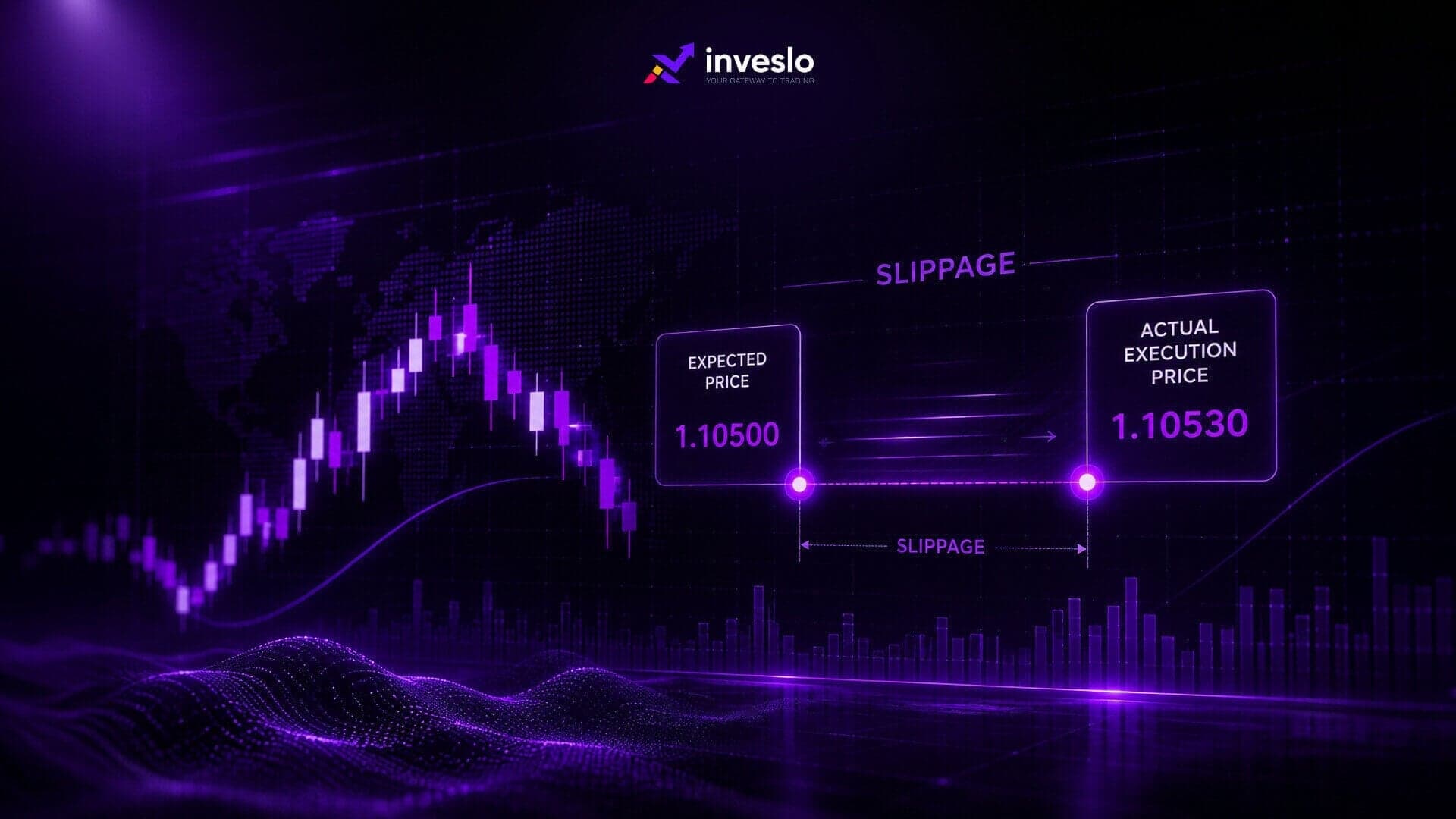
Slippage in trading costs most retail traders more than they realise, and it's rarely discussed until after the damage is done. You place an order at one price, it fills at another, and suddenly your trade is already underwater before the market's moved a tick against you. It happens fast.