
Skip to content
  • Partners

Instruments

  • Forex Trading
  • Spot Metals
  • Spot Energies
  • CFD Indices

Social

  • Copy Trading

Accounts

  • Accounts Overview
  • Standard
  • ECN Commission Free
  • ECN
  • Inveslo Premium
  • Demo Trading Account

Conditions

  • Leverage and Margin
  • Contract Specifications
  • Payment Methods

Platforms

  • MetaTrader 4
  • MetaTrader 5

Knowledge Hub

  • Blog
  • Trading Schedule
  • Trading Tools

Trading Tools

  • Pip Calculator
  • Margin Calculator
  • Profit Calculator
  • Trading Calculator
  • World Clock

About Us

  • Who we are
  • Company News
  • Financial Commission Certified
  • License and Certification
  • Contact Us
LoginRegister
Register
Menu
  • Instruments

    • Forex Trading
    • Spot Metals
    • Spot Energies
    • CFD Indices

    Social

    • Copy Trading
  • Accounts

    • Accounts Overview
    • Standard
    • ECN Commission Free
    • ECN
    • Inveslo Premium
    • Demo Trading Account

    Conditions

    • Leverage and Margin
    • Contract Specifications
    • Payment Methods

    Platforms

    • MetaTrader 4
    • MetaTrader 5
  • Knowledge Hub

    • Blog
    • Trading Schedule
    • Trading Tools

    Trading Tools

    • Pip Calculator
    • Margin Calculator
    • Profit Calculator
    • Trading Calculator
    • World Clock
  • About Us

    • Who we are
    • Company News
    • Financial Commission Certified
    • License and Certification
    • Contact Us
  • Partners
LoginRegister
  • Partners

Instruments

  • Forex Trading
  • Spot Metals
  • Spot Energies
  • CFD Indices

Social

  • Copy Trading

Accounts

  • Accounts Overview
  • Standard
  • ECN Commission Free
  • ECN
  • Inveslo Premium
  • Demo Trading Account

Conditions

  • Leverage and Margin
  • Contract Specifications
  • Payment Methods

Platforms

  • MetaTrader 4
  • MetaTrader 5

Knowledge Hub

  • Blog
  • Trading Schedule
  • Trading Tools

Trading Tools

  • Pip Calculator
  • Margin Calculator
  • Profit Calculator
  • Trading Calculator
  • World Clock

About Us

  • Who we are
  • Company News
  • Financial Commission Certified
  • License and Certification
  • Contact Us
  • English
  • Español
  • Português
  • فارسی
  • Tiếng Việt
Register
Menu
  • Instruments

    • Forex Trading
    • Spot Metals
    • Spot Energies
    • CFD Indices

    Social

    • Copy Trading
  • Accounts

    • Accounts Overview
    • Standard
    • ECN Commission Free
    • ECN
    • Inveslo Premium
    • Demo Trading Account

    Conditions

    • Leverage and Margin
    • Contract Specifications
    • Payment Methods

    Platforms

    • MetaTrader 4
    • MetaTrader 5
  • Knowledge Hub

    • Blog
    • Trading Schedule
    • Trading Tools

    Trading Tools

    • Pip Calculator
    • Margin Calculator
    • Profit Calculator
    • Trading Calculator
    • World Clock
  • About Us

    • Who we are
    • Company News
    • Financial Commission Certified
    • License and Certification
    • Contact Us
  • Partners
LoginRegister

Language

  • English
  • Español
  • Português
  • فارسی
  • Tiếng Việt
  1. Home
  2. Blog
  3. Forex
  4. What is a Trading Journal & How Do Traders Use It?
Forex

What is a Trading Journal & How Do Traders Use It?

IBy InvesloPublished: 17 September 20266 min read
Trading Journal
On this page

On this page

  1. What is a Trading Journal?
  2. What Should You Record in a Trading Journal?
  3. Why Keep a Trading Journal?
  4. 1. Check Whether Your Strategy Matches Your Results
  5. 2. Identify Execution Mistakes
  6. 3. Separate Strategy Problems From Behaviour Problems
  7. How to Maintain a Trading Journal?
  8. 1. Choose a Format You Will Actually Use
  9. 2. Record the Trade
  10. 3. Use Consistent Labels
  11. 4. Review the Journal on a Schedule
  12. What Most Trading Journals Get Wrong
  13. How Often Should You Review Your Journal?
  14. FAQs
  15. How do I start a trading journal?
  16. What is the main purpose of a trading journal?
  17. What should a trading journal include?
  18. How long should I keep a trading journal?
  19. Should I record losing trades too?

On this page

  1. What is a Trading Journal?
  2. What Should You Record in a Trading Journal?
  3. Why Keep a Trading Journal?
  4. 1. Check Whether Your Strategy Matches Your Results
  5. 2. Identify Execution Mistakes
  6. 3. Separate Strategy Problems From Behaviour Problems
  7. How to Maintain a Trading Journal?
  8. 1. Choose a Format You Will Actually Use
  9. 2. Record the Trade
  10. 3. Use Consistent Labels
  11. 4. Review the Journal on a Schedule
  12. What Most Trading Journals Get Wrong
  13. How Often Should You Review Your Journal?
  14. FAQs
  15. How do I start a trading journal?
  16. What is the main purpose of a trading journal?
  17. What should a trading journal include?
  18. How long should I keep a trading journal?
  19. Should I record losing trades too?

Share

  • Share on X
  • Share on LinkedIn
  • Share on Facebook
  • Share on Telegram
  • Share on WhatsApp

A trader can remember a big winner for months and forget three poorly planned trades from the same week. That is one reason relying on memory makes trade review difficult.

A trading journal solves that problem by creating a written record of what you traded, why you entered, how much you risked, what happened, and whether you followed your plan. It gives you something concrete to review instead of judging your trading from recent profit or loss alone.

A useful journal does not need to be complicated. The best version is one you can complete consistently and review without turning it into extra admin.

What is a Trading Journal?

A trading journal is a structured record of your trades and the decisions behind them.

A broker trade history usually shows information such as entry price, exit price, lot size, and profit or loss. A journal adds context. It records why the trade was taken, what setup was present, where risk was planned, and whether the trader followed the original idea.

That difference matters. A trade log tells you what happened. A trading journal helps you examine why it happened.

What Should You Record in a Trading Journal?

You do not need twenty fields for every trade.

Start with information that helps you answer useful questions later.

Field

What to Record

Why it Helps

Market

EUR/USD, gold, index, etc.

Shows where results differ

Direction

Buy or sell

Separates long and short performance

Entry and exit

Exact prices and times

Measures execution

Position size

Lots or units

Helps review risk

Stop and target

Planned levels

Shows whether the trade had structure

Setup

Breakout, pullback, reversal, etc.

Lets you compare strategy performance

Trade result

Profit or loss

Tracks outcomes

Notes

Reasoning, mistakes, emotions

Explains decisions behind the numbers

Screenshots can also help. Saving the chart at entry and exit gives you a visual record of what you saw before hindsight changed your interpretation.

For forex traders, recording the session can be useful too. EUR/USD traded during London hours may behave differently from the same pair during a quieter period.

Why Keep a Trading Journal?

The main benefit is better review.

Without records, traders often judge a strategy from a small group of recent trades. A journal creates enough information to compare decisions across a larger sample.

1. Check Whether Your Strategy Matches Your Results

Suppose you trade breakouts.

After 40 recorded trades, you might find that your setup performs differently by session, instrument, or market condition. You may also find that many losses came from trades that did not actually meet your rules.

That is more useful than saying, “My breakout strategy stopped working.”

The journal gives you something specific to examine.

2. Identify Execution Mistakes

Two traders can use the same strategy and produce different outcomes because their execution differs.

A journal can show repeated behaviours such as:

  • Entering before confirmation
  • Moving a stop farther away
  • Closing profitable trades too early
  • Increasing size after a loss
  • Trading outside planned hours

Those patterns can be difficult to spot one trade at a time.

3. Separate Strategy Problems From Behaviour Problems

A losing trade does not automatically mean the strategy was wrong.

If the entry followed your plan, position size stayed within your risk rule, and the market simply moved against you, the process may still have been sound.

A profitable trade can also be poorly executed.

For example, entering without a setup and getting lucky should not receive the same evaluation as a trade that followed the plan.

A journal helps separate good processes from good outcomes.

How to Maintain a Trading Journal?

The process should be simple enough to repeat.

1. Choose a Format You Will Actually Use

You can keep a trading journal in:

  • A spreadsheet
  • A notebook
  • A dedicated journaling tool
  • A document or database

Digital formats make filtering and calculation easier. Handwritten journals can work well for reflection.

There is no universal best format. The practical choice is the one you will continue using.

2. Record the Trade

Record the setup, entry reason, stop, target, and position size close to the time of the trade. Add the result and post-trade notes after closing it.

This reduces the temptation to rewrite the original reasoning after seeing what the market did.

3. Use Consistent Labels

If one trade is labelled “breakout,” another “range break,” and another “resistance breakout,” you may struggle to compare them later even if they describe the same setup.

Create simple labels and keep them consistent.

The same applies to sessions, strategies, instruments, and mistakes.

4. Review the Journal on a Schedule

Recording without reviewing limits the value of the journal.

A weekly review works well for many active traders because it gives enough trades to examine while the decisions are still familiar. Competitor guides commonly place regular review at the centre of the journaling process rather than treating logging as the final step.

What Most Trading Journals Get Wrong

The main problem is usually complexity.

A trader creates a detailed template, records fifteen variables for every trade, then stops using it after a week.

Start smaller.

If you can consistently record the market, setup, entry, exit, risk, result, and one sentence about execution, you already have enough information to begin reviewing patterns.

Another problem is selective recording.

If you journal only unusual trades, large losses, or trades you are proud of, your data becomes biased. A useful journal needs the ordinary trades too.

The final mistake is focusing only on P&L.

Profit and loss matter, but they do not explain whether the trade followed the plan. A journal should measure process alongside outcome.

How Often Should You Review Your Journal?

For active traders, a weekly review is a practical starting point.

Daily review can help after unusual trades, but reviewing every small result immediately can lead to overreacting to short-term outcomes.

Monthly reviews work better for broader questions, such as whether a strategy is still producing results across a larger set of trades.

Use different review periods for different purposes:

  • After the trade: Check execution
  • Weekly: Find repeated mistakes or strengths
  • Monthly: Compare broader strategy results

FAQs

How do I start a trading journal?

Choose a notebook, spreadsheet, or journaling tool and record the same basic fields for every trade. Keep the first version simple.

What is the main purpose of a trading journal?

A trading journal helps you review your decisions, execution, risk, and results across multiple trades instead of relying on memory.

What should a trading journal include?

Record the market, entry, exit, position size, stop, target, setup, result, and short notes about why you took the trade.

How long should I keep a trading journal?

Keep it for as long as you trade. A larger history gives you more information to compare across strategies and market conditions.

Should I record losing trades too?

Yes. Leaving out losses distorts the journal and makes strategy analysis less reliable.

Share

  • Share on X
  • Share on LinkedIn
  • Share on Facebook
  • Share on Telegram
  • Share on WhatsApp

Related articles

  • Consumer Price Index CPI
    ForexInveslo

    What is the Consumer Price Index (CPI)?

    The Consumer Price Index (CPI) tracks the average change over time in prices consumers pay for a representative basket of goods and services. It is one of the main measures used to monitor consumer inflation.
    Read More17 September 2026
  • Slippage in Trading
    ForexInveslo

    Slippage in Trading: What it is and How to Reduce it?

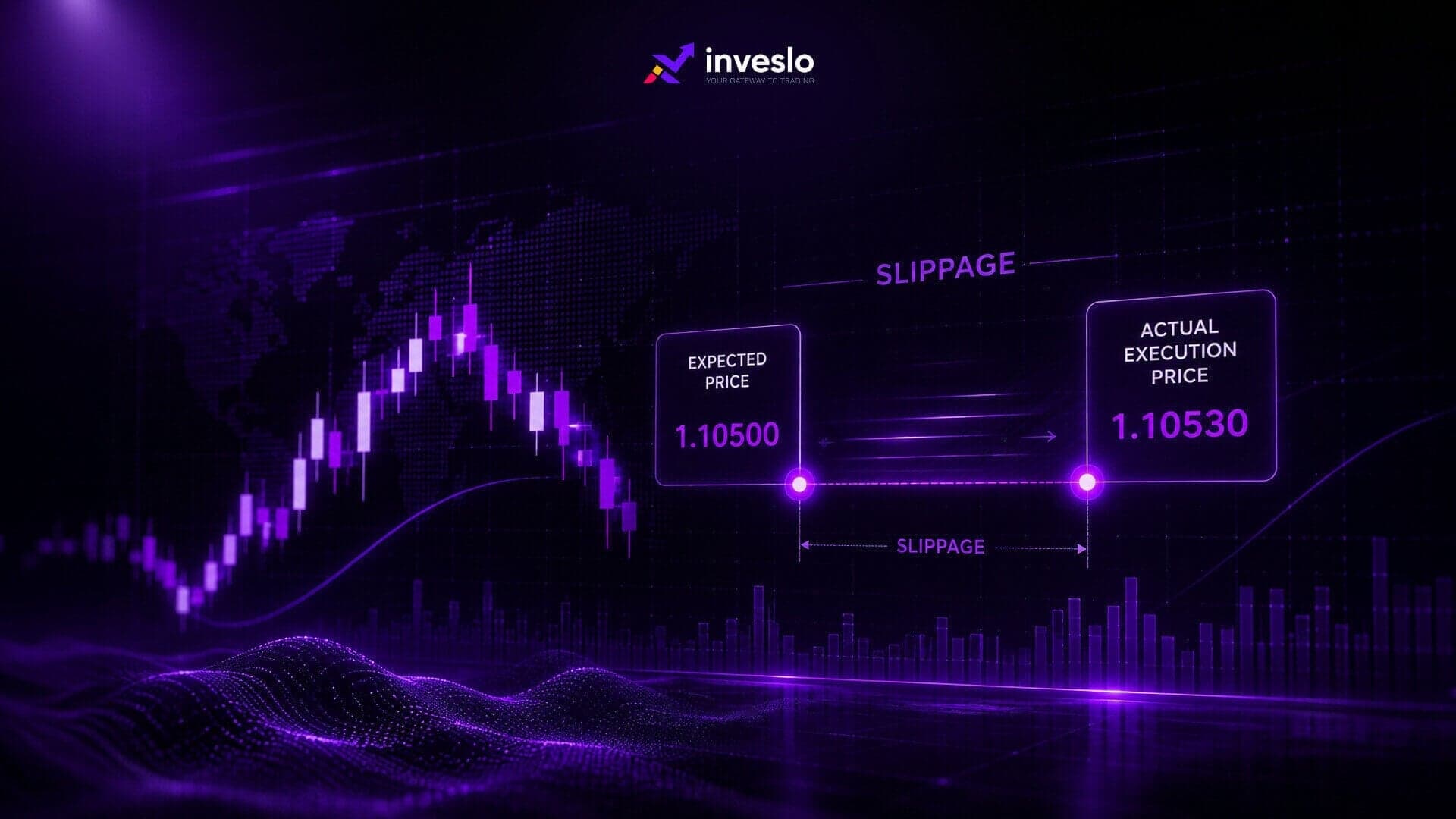
    Slippage in trading costs most retail traders more than they realise, and it's rarely discussed until after the damage is done. You place an order at one price, it fills at another, and suddenly your trade is already underwater before the market's moved a tick against you. It happens fast.
    Read More11 September 2026
  • NFP trading
    ForexInveslo

    What is NFP (Non-Farm Payrolls) and How it Moves the Forex Market?

    NFP forex trading turns the first Friday of every month into something most traders dread and anticipate in equal measure. No other scheduled data release moves currency pairs this fast, this far, or this unpredictably.

    Read More8 September 2026

Your next tradestarts here

Open your free account, verify in minutes, and trade the world's markets with a broker that's on your side.

Open Free AccountTry Free Demo

Trading involves risk. Manage capital wisely.

Footer

Your gateway to the world’s markets, giving you access to global trading opportunities with a fully regulated, award-winning broker trusted by over 1M traders worldwide.

Follow us:

  • Who we are
  • Deposits & Withdrawals
  • Partners
  • Risk Disclosure
  • Accounts Overview
  • CopyTrading
  • Privacy Policy
  • Refund Policy
  • AML Policy
  • Contact Us
  • Client Agreement

Disclaimer

  • →Regulated by FSC Mauritius

    Inveslo Limited, registered in Mauritius with registration number C230595 and office at C/o Legacy Capital Ltd. Second Floor, Suite 201, The Catalyst Ebene, is regulated by the Financial Services Commission of the Republic of Mauritius. Holding an Investment Dealer License, GB25205645, Inveslo adheres to strict regulatory standards, ensuring client protection, transparency, and a secure trading environment worldwide.

  • →Kazakhstan Regulatory Accreditation

    Inveslo Trading Ltd. is incorporated in the Republic of Kazakhstan with Business Identification Number 210540039066 and has been registered as Financial Services Provider with the Ministry of Economy. The company is entitled to provide the following services to customers within and outside the Republic of Kazakhstan according to the accreditation issued by the Agency for Regulation and Development of the Financial Market of the Republic of Kazakhstan, dated 13-07-2021 and file number 16-8-09/3T-C-167: Payment Processing / e-wallets, Forex Services and Crypto Currency Services.

  • →Financial Commission Membership

    Inveslo is a member of The Financial Commission, an independent external dispute resolution (EDR) organization, allowing the company and its customers a wide range of services and membership benefits including customer protection in case of disputes, up to €20,000 per case. As a FinCom certified broker, our customers are insured for the safety of funds.

  • →Risk Warning

    Trading forex and other financial instruments involve a high level of risk and may not be suitable for all investors or traders. Traders must carefully consider their trading objectives, financial situation, risk appetite, and level of experience before stepping into margin trading with Inveslo. There a risk of losing more than the trader’s initial investment. The higher the leverage, the more the risk, which can go against you. Traders are advised to be aware of the associated risks.

  • →Intellectual Property Rights

    Any kind of unauthorized publication, duplication, or quotation from the Inveslo website, without prior consent from Inveslo, will be constituted as a violation of intellectual property rights and will be subject to litigation. This includes any unauthorized use of the brand name, logos, images, agreement, etc.

  • →Crucial Insights

    All the information on this website is solely for educational purposes and is subject to change at any given time without any prior notice. The contents mentioned on the website do not constitute investment or trading advice. Inveslo has taken measures to ensure the accuracy of the information provided on this website, however, does not guarantee it. Inveslo is not, in any way, liable for the losses that might occur directly or indirectly from the reliance on or the usage of the website’s contents.

  • →Restricted Regions

    The information in this content is not intended to be provided to residents of the USA, Canada, Haiti, Suriname, North Korea, Puerto Rico and is not intended to be distributed or used by anyone in any country or jurisdiction area, as in the country or jurisdiction.

  • →Payment Agent

    CXDT Global LTD (Cyprus), with registration number HE448937, registered office at Aiolou & Panagioti Diomidous 9 Katholiki, 3020 Limassol, Cyprus, is the payment agent processing on behalf of Inveslo Trading LTD with Business Identification Number 210540039066.

  • REGULATED & TRUSTED
  • FSC Mauritius
  • The Financial Commission
  • Negative-Balance Protection
  • Segregated Funds

Risk Warning: Trading Forex and CFDs carries a high level of risk to your capital and may not be suitable for all investors. Leverage can work against you as well as for you. Before trading, ensure you fully understand the risks involved.

Part of XGroup's Legacy, Advancing Wealth Management Innovation

© 2026 Inveslo.com - All Rights Reserved

Language

  • English
  • Español
  • Português
  • فارسی
  • Tiếng Việt